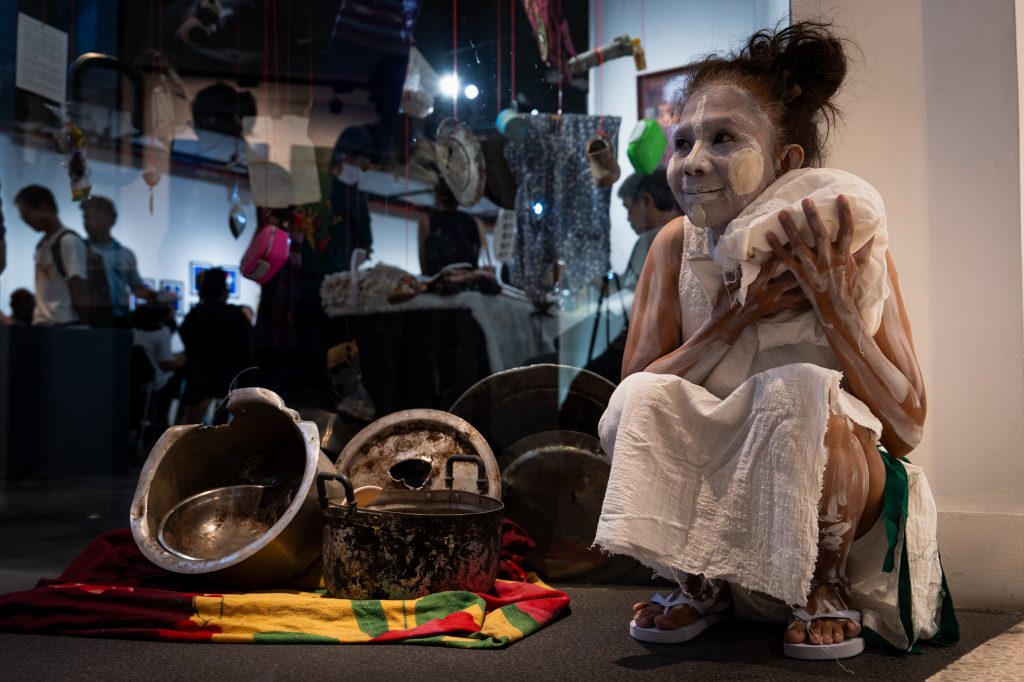
Bangkok, Thailand, March 2026 – Five years after the Myanmar military’s attempted seizure of power, civil society actors, artists, and regional experts gathered in Bangkok for Blooming in Crisis: Uncomfortable Truths in Myanmar, a public exhibition and series of dialogues hosted at the Bangkok Art and Culture Centre (BACC).
Jointly organised by Spirit in Education Movement (SEM), Asia Justice and Rights (AJAR), and Amnesty International Thailand, the programme combined art, performance, policy dialogue, and community healing practices to sustain regional attention on Myanmar’s ongoing crisis beyond electoral narratives promoted by the military regime.
Held from 12 February to 1 March 2026, the exhibition reached more than 10000 visitors through the high-footfall public cultural space of BACC, alongside livestream audiences and digital circulation. This scale of engagement reflects sustained regional concern and demonstrates that Myanmar’s crisis continues to resonate within Thailand’s civic sphere.
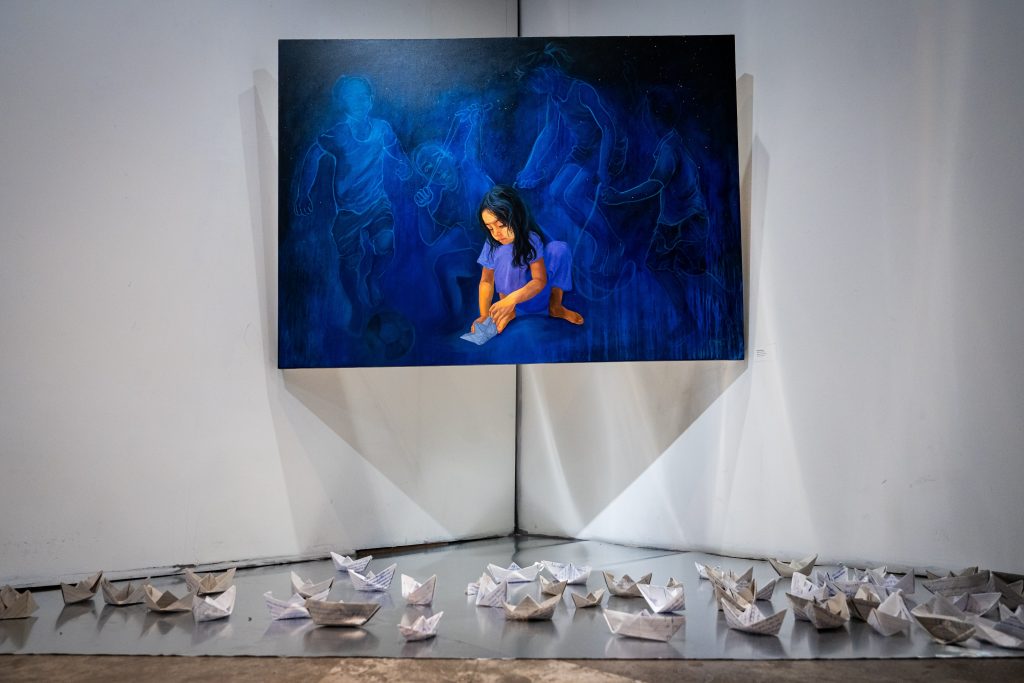
Art as Civic Space: Opening the Conversation
The opening day programme moved deliberately from music and participatory engagement toward reflection and structured dialogue. A live musical performance created a shared entry point, followed by an interactive refugee simulation board game, If You Have to Flee, which invited participants to confront the constrained decisions displaced people face.
Sound and performance art further deepened the experiential dimension of the exhibition, before artist speeches and a guided tour anchored the artworks within broader political and ethical questions.
Rather than presenting the crisis solely through statistics, the curatorial design centered on lived experience, foregrounding displacement, resilience, memory, and collective endurance.
The exhibition’s thematic pillars, People’s Power, Uncomfortable Truths, and Way Forward, framed the gallery not only as a commemorative space but as a site of critical engagement.
From Reflection to Analysis: Regional Policy Dialogue
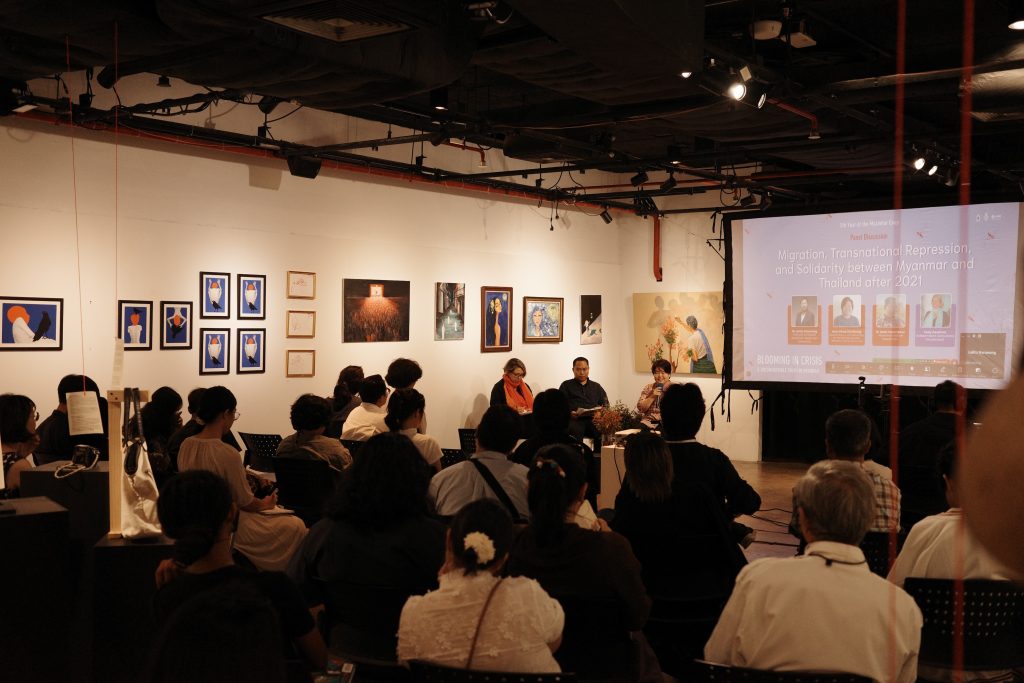
On 14 February, a public panel discussion, conducted in Thai with English interpretation and livestreamed online, built on the themes of the exhibition and examined their broader political implications. Panellists included veteran human rights activist Khin Ohmar, environmental justice advocate Pianporn Deetes, and journalist Supalak Ganjanakhundee, moderated by Wipaporn Wuttanawit.
Panellists discussed a wide range of issues linked to Myanmar’s ongoing crisis, including the escalating humanitarian emergency marked by mass displacement and systematic repression. They also examined the growing use of surveillance technologies and the resulting shrinkage of civic space, as well as the environmental and economic impacts felt along the Thai–Myanmar border. The conversation touched on broader geopolitical dynamics involving China, India, the United States, and ASEAN, while also assessing Thailand’s diplomatic approach and the limitations of the region’s longstanding policy of non-interference.
Speakers highlighted the growing reliance on people-to-people humanitarian mechanisms due to restricted international access inside Myanmar, and the development of local governance systems in areas controlled by resistance groups.
Speakers also stressed that the impact of Myanmar’s crisis extends far beyond the country’s borders, affecting migration, border security, environmental issues, and regional relations throughout Southeast Asia.
Transnational Repression, Migration, and Gendered Vulnerabilities
The closing panel on 28 February expanded the lens further to examine transnational repression, migration governance, and gendered labour exploitation.
Experts analysed how authoritarian control extends across borders through surveillance, documentation revocation, deportation risks, and proxy intimidation. Migration was reframed not merely as economic mobility, but as a site of layered vulnerability where legal precarity intersects with gendered exploitation and limited institutional protection.
The event concluded with a screening of the Vietnamese documentary 50 Years of Forgetting, situating Myanmar’s struggle within broader Southeast Asian memory politics and post-conflict silence. The film reinforced a central question of the exhibition: What must be remembered — and transformed — to prevent repetition?
Embodied Solidarity: Dances of Universal Peace
Beyond dialogue, the programme included a circle-based community healing session, Dances of Universal Peace, attended by 28 participants. Through collective movement and song, the activity translated solidarity into embodied practice affirming that hope and people’s power continue to bloom even amid crisis.
Beyond Commemoration: Advancing Transformative Regional Engagement
Blooming in Crisis demonstrates how cultural spaces can function as platforms for regional civic education. By situating Myanmar’s crisis within Thailand’s public sphere, the exhibition challenged narratives of distance or fatigue.
Importantly, “uncomfortable truths” were addressed both internally and externally — examining fractures within Myanmar’s struggle while also confronting international enablers, border political economies, and policy constraints within neighbouring states.
Rather than framing hope as an abstraction, the programme foregrounded actionable pathways: alternative humanitarian channels, migrant economic integration, pragmatic regional diplomacy, and sustained civil society coordination.
As Myanmar’s future remains contested, the Bangkok gathering reaffirmed that solidarity must be grounded in accountability, courage, and long-term commitment.
Five years on, the crisis endures but so too does the collective determination to imagine and build a democratic and federal future.