New York & Sydney, 27 October 2025 – During the 2025 Women, Peace and Security (WPS) Week, Asia Justice and Rights (AJAR) was invited to present at a side-event titled “Peace by Piece: Addressing Conflict-Related Sexual Violence throughout the Peace Continuum; Lessons from the Asia-Pacific.” The week-long commemoration, starting October 27, 2025, marked the 25th anniversary of UN Security Council Resolution 1325.
AJAR Director, Galuh Wandita, delivered a four-minute video presentation, sharing insights on interim reparative measures for survivors of conflict-related sexual violence (CRSV) in Timor-Leste, a project supported by the Global Survivors Fund (GSF). Her presentation was part of the “During Conflict” discussion stage, alongside lessons from Nepal by Susan Risal. This segment explored how reparative measures and support for survivors can establish sustainable peace, even in the face of persistent impunity.
The side-event was co-hosted by several organizations, including the Permanent Mission of Australia to the UN, the Permanent Mission of Timor-Leste to the UN, UN Action Against Sexual Violence in Conflict, the Southeast Asian Women Peace Mediators, the Team of Experts on the Rule of Law and Sexual Violence in Conflict, and the Global Survivors Fund. Its goal was to bring together a diverse group of stakeholders, including survivors, civil society leaders, mediators, UN officials, and legal experts from the Asia-Pacific, to discuss survivor-centred approaches to preventing and addressing conflict-related sexual violence (CRSV). The discussions also highlighted how initiatives across the peace continuum (before, during, and after conflict) lay the groundwork for justice, accountability, and reconciliation.
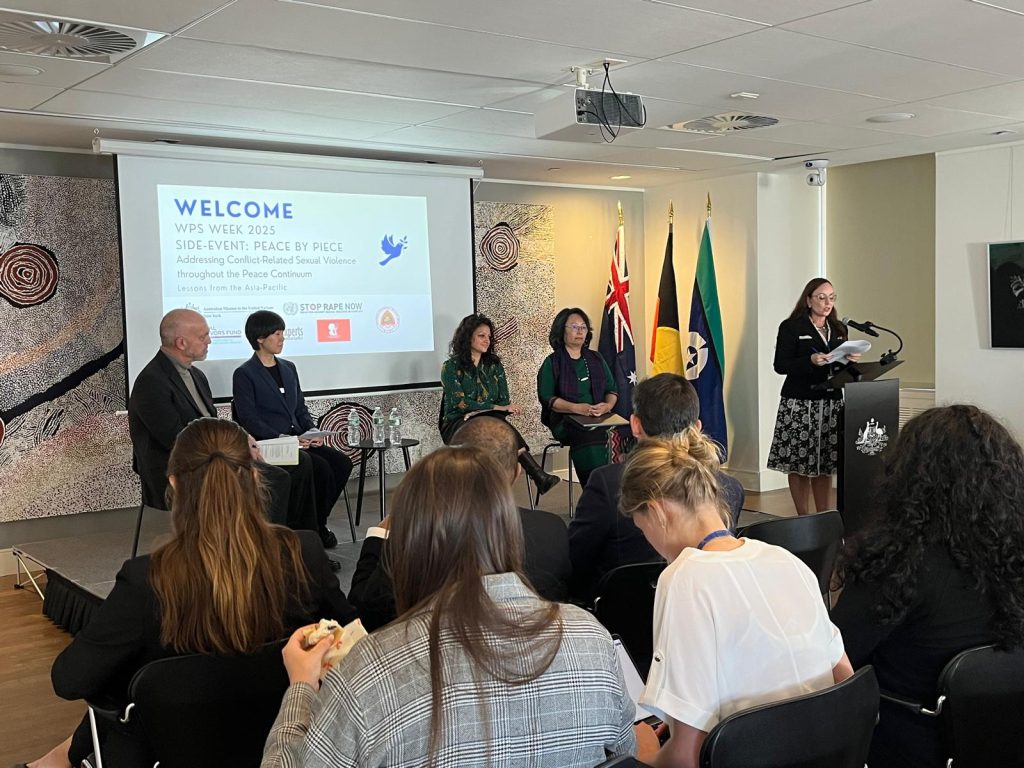
Galuh Wandita emphasized that “the WPS agenda cannot be fulfilled when there is continuing impunity for victims of CRSV.” However, she added, “survivors are not passive; they are active agents of peacebuilding and accountability.” Through participatory methods, AJAR, in collaboration with Asosiasaun Chega ! Ba Ita (ACbit) empowers survivors to advocate for reparations.
The experiences of survivors were crucial in demonstrating the importance of a continuum of care and offered significant insights into alternative measures for responding to CRSV and delivering reparations. These grassroots initiatives underscore how co-creation approaches and survivor agency can facilitate reparations, a mechanism survivors have long been denied.
Since its inception, AJAR has been working in Timor-Leste, supporting women survivors of the prolonged Indonesian occupation from 1974 to 1999. Since 2022, AJAR, ACbit, and survivor groups, with support from the GSF, have implemented Bukae (meaning “basket” in Tetun), an interim reparative measure for women conflict survivors in Timor-Leste.
See the full video presentation “A Lesson from Timor-Leste on Interim Reparative Measures” here.