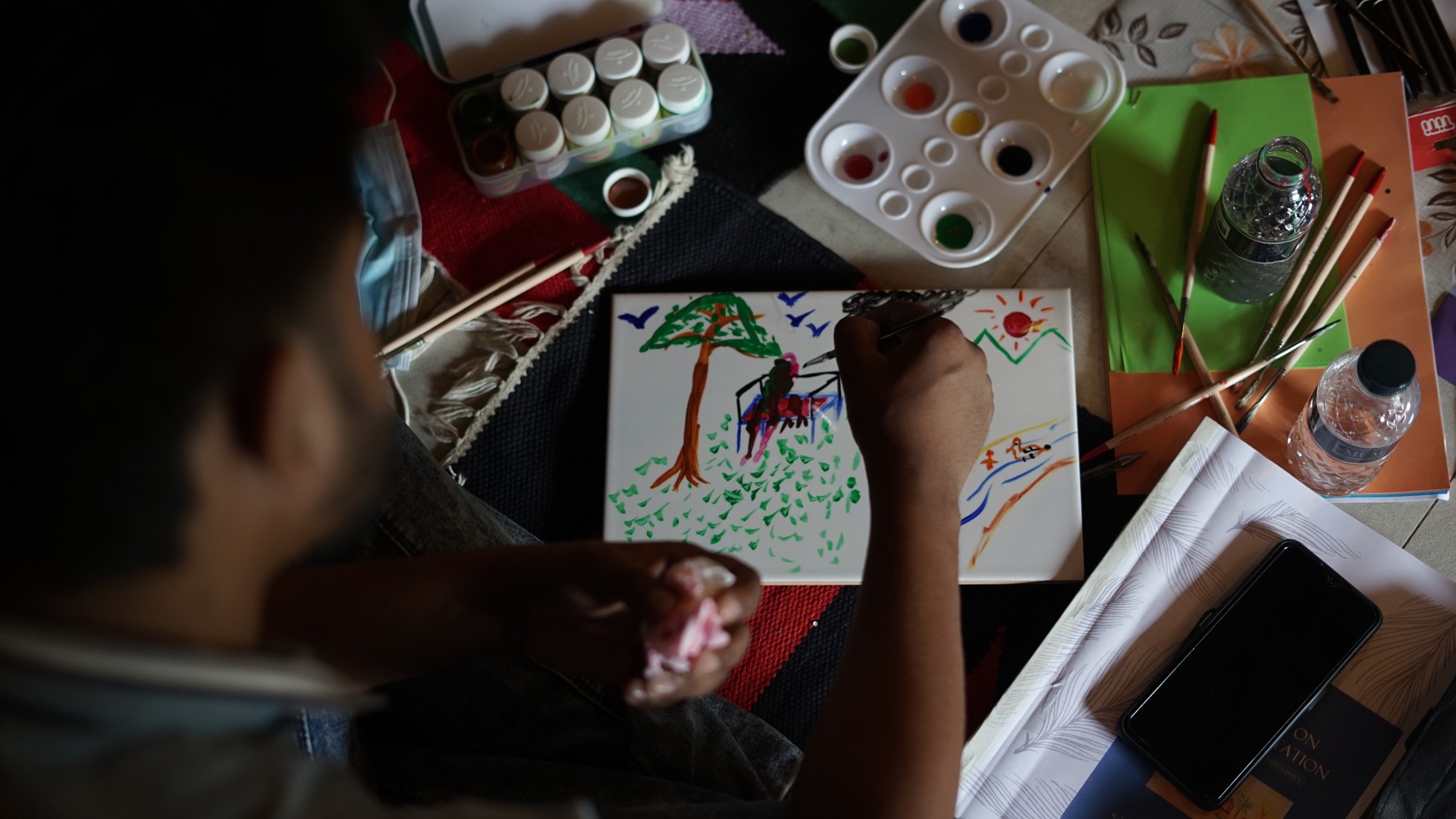
Hanifa

Hanifa

“I feel much safer than I did before, but camp life is so difficult. I had everything in Myanmar but we were forced to leave. I lost my house, my garden, our goats, our land. I have nothing left to lose. I want justice for what the Myanmar military did to us.

It’s been a long time that they have deprived us of our rights. If we get back our citizenship rights I will go back to my country. If we try to return without justice, there is no guarantee that anything will change.”

“I am personally so happy to take part in AJAR activities, I learn so much by taking part in the workshops. I hope there will be many more in the future.

As I have problems with my mobility, I hope I can have access to a sewing machine so I can help to support my family and contribute to our daily needs.”

Hawa

Hawa

“Hawa started studying in the madrasah when she was 5 years old. She really enjoyed her life. But Hawa witnessed many atrocities. “Because of conflict, I saw many dead bodies in the river. People were screaming. So many were children crying because of hunger.”

After the Myanmar military burnt down her house, she decided to escape to Bangladesh by river. When she dreams, Hawa she sees her home, her land, her cows, her trees.

“I had everything in Myanmar, now I have nothing. I want to go back to my country as soon as possible and start a new life there. But first there must be justice.”

Hadeeqah

Hadeeqah

Hadeeqah and her family arrived in Bangladesh on 12 September 2017. “The Friday before we arrived the military burnt down the houses in the neighbouring village.

The people from that village took shelter in our village. And then two or three days later the military moved into our village opening fire with their guns and their tanks.

We had no choice but to escape when we heard that they had set fire to all our homes and burnt them to the ground.”

Hanin

Hanin

Hanin is married with two young children, a boy and a girl. She is very grateful for the AJAR activities that she has taken part in, especially the workshops on human rights and justice.

She is worried about her children’s education in the camps, particularly during the pandemic. Hanin was only able to study in school until second grade because of financial difficulties. She had hoped for so much more for her children.

Hajjah

Hajjah

Hajjah is married with three children. Both Hajjah and her husband are looking for work in the refugee camp, but it’s very difficult. So far they haven’t had any luck finding a job.

Although she is busy taking care of her children and her husband, unemployment leaves them with too much time to dwell on the atrocities they witnessed. The atrocities that led them to Bangladesh and life in the refugee camps.

Heba

Heba

Heba and her husband are teachers. They had a very peaceful life back in Myanmar. Now they live in Burmapara with their daughter. They are fortunate, she says, because her husband works on an education programme, though it is still a struggle to survive on his wages.

Heba enjoys taking part in the AJAR workshops.

“Before the workshops, I didn’t know anything about justice and human rights. I would like to learn how to work with survivors so that I can support others. But I also want to improve my sewing skills so that I can help support my family.

Iqra

Iqra

Iqra was 13 when she escaped to Bangladesh with her mother and her brother. Her parents divorced when she was very young and her father lives with his new family.

Iqra lives with her mother and her brother, who has special educational needs. They lived a very modest life in Myanmar, relying on money sent by relatives working overseas.

Life continues to be a struggle for Iqra and her family, relying on food rations and support from relatives, when they can afford it.

Iman

Iman

Iman is 18 years old. The Myanmar military killed her mother and arrested one of her brothers. Iman has no idea where her brother is nor whether she will ever see him again.

Her father left for Malaysia many years ago, and is no longer in touch with Iman and her six siblings.Iman feels very sad and believes that the international community should bring the Myanmar military to account.

“The Rohingya should have all their rights restored,” she says, “including citizenship rights.”

Jumanah

Jumanah

Azida’s husband was arrested by the Myanmar military, so she was forced to make her way to Bangladesh alone. Now she lives in the refugee camp with one of her brothers and his wife.

Her brother raised Azida and her six brothers and sisters after their parents died. She is grateful for his protection. Azida believes the international community has an important role in restoring the Rohingya’s right to return to their homeland.

“Myanmar has tortured us for a long time, denied our citizenship and forced us to come to Bangladesh. We need the help of the international community.”

Karima

Karima

Karima’s and her mother were in their house when the military attacked. “They set fire to our house we were still inside”. Her mother didn’t realise what was happening at first as she was deaf and mute, and then it was too late.

“She couldn’t move because she was in shock. I managed to escape but my mother couldn’t move. The military burned our house to the ground, and my mother died inside. One day, maybe I can get back to my homeland, but I will never be able to see my mother again.”

Karima’s mother was killed by the Myanmar military when they set their home on fire, with her mother was still at home. Karima pins her hopes on the international justice system.

“We are not Bengali,” she insists, “Myanmar considers us Bengali but we are Rohingya and we belong to Myanmar. We want recognition and we want to go home.”

Khadija

Khadija

At one of AJAR’s workshops, Khadija felt she had finally found a safe space and opened up to the other participants.

“I lost my dignity. The Military raped me. I feel sad remembering how badly they treated us. Just because we are Muslim, they feel they can torture us.”

Khadija believes that the international community should do more to put pressure on the Myanmar government and support the Rohingya “We are not Bengali, we are Rohingya, citizens of Myanmar. We want recognition of that.”

Khawla

Khawla

“I had a sister who with special educational needs. Because of the conflict, I was unable to bring her with me. She was murdered by extremist Buddhist monks. I miss her. And like everyone else, I also lost my house, my property, my land.”

Khawla had to pay 10.000 Kyat to make the three-day journey to Bangladesh. She ate nothing and had no sleep. The children on the boat cried with hunger, they just wanted to go home. Khawla wants justice so she can go back home to Myanmar.

“I had a sister who with special educational needs. Because of the conflict, I was unable to bring her with me. She was murdered by extremist Buddhist monks. And like everyone else, I also lost my house, my property, my land.”

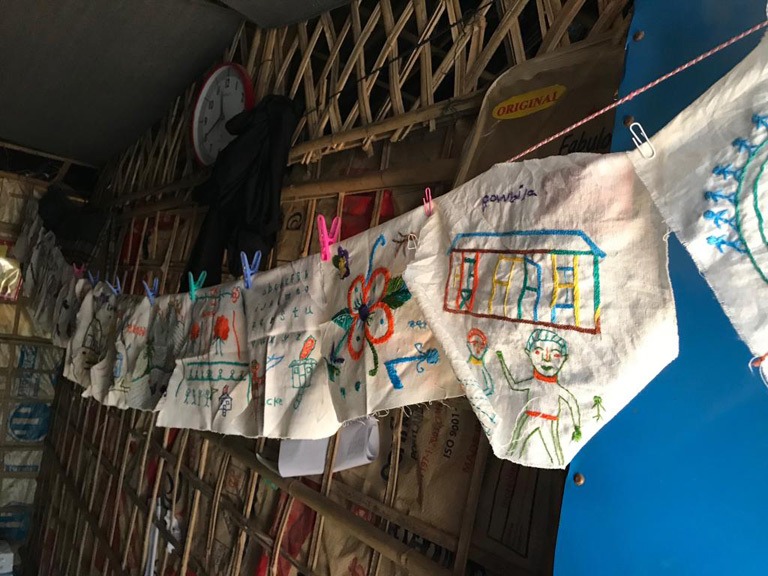
Khawla wants justice so she can go back home to Myanmar, but her immediate need is a livelihood so that she and her family can survive. “I embroidered an image of money because it symbolises the basic necessities and our present situation. We are poor, we are living in poverty.”

Khalida

Khalida

Khalida was raped by soldiers in Myanmar. She was shot in the leg and the face. Her daughter remains in Myanmar, held captive in a military camp.

Khalida is trying to survive. She shares her approach to resilience and survival through her embroidery, a quilt panel depicting a jug and a pond.

“When the water from the pond is poured into the jug, it takes the shape of the jug. I am like the pond water and the jug is my present situation. I have to adapt. Whenever you see water and a jug, you will see me.”

She was shot in the leg and the face. Her daughter remains in Myanmar, held captive in a military camp.

Khalida is trying to survive. She shares her approach to resilience and survival through her embroidery, a quilt panel depicting a jug and a pond.

“When the water from the pond is poured into the jug, it takes the shape of the jug. I am like the pond water and the jug is my present situation. I have to adapt. Whenever you see water and a jug, you will see me.”

Khalida was raped by soldiers in Myanmar. She was shot in the leg and the face. Khalida escaped to Bangladesh despite her injuries, but her eldest daughter remains in Myanmar, held captive by the military.

The injuries caused by the rape give Khalida pain to this day. Khalida is trying to survive. “When pond water is poured into a jug, it takes the shape of the jug. I am the pond water and my life is the jug. I have to adapt to survive.”

AJAR’s activities provide Khalida with a safe space in which to talk about living as a survivor of rape. According to Khalida, human rights education provides a safe space, a comfort zone for survivors and helps them dream about a better future.

“There are many people who don’t want to know our story, our situation, our history. International human rights organisations can ensure that the whole world knows about us, the Rohingya. Then the people who deny our truth can no longer get away with it.”

Lana

Lana

Lana has four children, two boys and two girls. They used to live by a river where the children would swim and hunt for fish.

Conditions in Lana’s village became very dangerous, forcing her husband to flee to Bangladesh ahead of Lana and their children. Then, Lana’s father was killed by the military and their home was burnt to the ground.

They lost everything. Lana witnessed many shootings. The escape to Bangladesh was arduous. “Those days still haunt me,” says Lana.

Lana has four children, two boys and two girls. They used to live by a river where the children would swim and hunt for fish. When the military attacked her village, Lana witnessed many shootings.

“The military killed my father, burnt my house down. I had to leave my land, our property. My Myanmar sisters’ dignity was stolen by the soldiers who raped them.”

Human rights education has inspired Lana to help other survivors. She hopes that she can pass the knowledge on to her children and help them to have a better future.

“They called Muslims ‘kalla’ and told us that we would all have to go to Bangladesh. To be honest I didn’t really understand what they were talking about, but now I understand, that they want to destroy us, force us into exile, occupy our lands, our property.

Even though we had identity cards, they still forced us to come, even though my husband was working for the government. It was the Myanmar military that forced us to come to Bangladesh.”

Before taking part in the AJAR training, Lana spent all day thinking about the past: the horrors she had witnessed, all that she had lost and worrying about the future.

“I am so happy to come here and learn. It stops me thinking about my problems. Now when I’m at home I think about the training, I dream about the training. It helps us to work out solutions to our problems by ourselves and hopefully go back to our country one day.

Now at night time when I see the moon and stars it feels very good.”

Lara

Lara

Lara was six-months pregnant. She saw the soldiers shoot and kill her father-in law. She heard how the soldiers killed her grandfather.

They tied him up in his home, locked the door and set the house on fire. Soldiers raped Lara, and left her for dead. She was found unconscious by her neighbours. Lara hid in the forest for three days, bleeding. Lara lost her baby.

“They took everything, even my dignity. I was raped by the military and my baby died”

She was raped by soldiers when she was six months’ pregnant and lost her baby. She saw the solders kill her father-in-law.

They locked her grandfather in his home and set the house on fire. Learning about human rights gives Lara hope. “The chance to share and reflect helps me become stronger. When the moonlight falls on a flower, it starts to bloom.

My life is like this. After the dark memories of my life, I’m blooming like a flower. The Moonlight is the knowledge making me stronger day by day.”

Lara is a rape survivor. She was raped by soldiers when she was six months’ pregnant and lost her baby. She saw the solders kill her father-in-law. They locked her grandfather in his home and set the house on fire.

Learning about human rights gives Lara hope.

“There are many people who don’t want to know about us, don’t want to hear our story, our history. If the international community did more to promote justice for us, the whole world could learn about us. We are Arakan Rohingya. Please stop the genocide. We wait for justice.”

Latifa

Latifa

Latifa is a widow. Her husband, who was a local leader, was shot and killed by the Myanmar military in his place of work. When she saw a military convoy ride into a village she ran for shelter, and then escaped to Bangladesh.

The ability to communicate is very important for Latifa.

“Mobile phones allow us to reach people easily. It means we can stay connected and being connected is important. Whenever anyone needs me, I am can be there for them.”

Latifa is a widow. Her husband, who was a local leader, was shot and killed by the Myanmar military in his place of work. When she saw a military convoy ride into a village she ran for shelter, and then escaped to Bangladesh.

Back in Myanmar Latifa and her family kept chickens and grew lots of fruit and vegetables in the garden including spinach, aubergines, tomatoes, okra, pumpkin, peas and butternut squash. She wishes she could go back to living independently again.

Lina

Lina

Lina is married with three children, one boy and two girls. Lina’s husband was shot by the military during their escape to Bangladesh and her son sustained other injuries.

They both survived but the son remains traumatised and is living with mental illness.

Loulia

Loulia

Loulia has learnt a lot about rights and justice in AJAR’s workshops. The principle of non-discrimination is very important to her.

“But Myanmar doesn’t follow this principle. They deny our rights and they discriminate against us. If they don’t change their view of us then we Rohingya have to live like floating flowers with nowhere to put our roots. Until the Rohingya receive justice and have their rights restored, we are tied up in chains, but told to live normally”

Loulia lived with her husband, their children and her in-laws in a village where they raised chickens and grew okra, pumpkins, potatoes, beans, peas and rice. The family had to flee to Bangladesh when the military attacked their village and burnt their home to the ground.

Loulia tries to remain positive for the sake of her family and her community. She doesn’t share her sadness and tries to show her happy face so that people feel calm and comforted.

Maha

Maha

It took Maha two weeks to reach Bangladesh under treacherous conditions. Along the way she was separated from her mother, father, brother and sister and hasn’t seen them since.

She has no idea whether they are still alive. Maha enjoys the human rights workshops, but was disappointed to learn that the ICC is unlikely to be of help, but is hopeful that crimes of deportation may offer a solution.

She feels that if international community had stepped in much sooner, perhaps the Rohingya would have kept their citizenship rights and still be in Myanmar.

Malak

Malak

Malak was able to attend university because her great-grandfather had an identity card, but was forced to quit because of the security situation.

She remembers the attacks began in 2012, when the army stormed the village and set fire to their houses. The same thing happened in 2017. The military set the village on fire, killed, tortured and raped. It was terrifying.

Malak’s husband fled across the border ahead of her. She travelled four days by car, trying to avoid the blockades. Then she took a small boat. When she finally arrived in Bangladesh, Malak and her husband were reunited.

Malak wants to become a human rights educator in order to help others. Most importantly, she wants to support women’s empowerment.

“Sometimes it’s difficult for women to open up about their experiences with their family. At that time they need a friend, a safe space to talk and reflect. It is important to share knowledge, to promote mutual respect and listen carefully to what people want to say.”

Since setting up the women’s empowerment group, Malak is very conscious of time. “Now I need to make time, be on time, make the best use of my time.”